








Why Use A Cellular Measuring Guide?
A cellular measuring guide ensures precise custom fits for honeycomb shades, crucial for maximizing insulation (up to 60% energy savings) and aesthetic alignment. VeilVeil’s guide factors in window irregularities, mounting depth, and fabric tension—avoiding light gaps or operational strain. Unlike generic tape measures, it streamlines dimension accuracy for top-down/bottom-up designs. Pro Tip: Always measure during daylight to spot warped frames that skew night-time readings.
What defines a VeilVeil cellular measuring guide?
VeilVeil’s tool combines custom templates and step-by-step instructions to map shade dimensions, including recessed vs. outside mounts. Unlike standard rulers, it factors in cell size (3/8" to 1") and stacking height. For example, measuring a 24"x36" window with a ½" cell requires adding ⅛" buffer to prevent friction. Always cross-check horizontal/vertical thrice—shifting ¼" can misalign light gaps.
Why does precision matter for cellular shades?
Cellular shades rely on airtight seals—a 1/8" gap cuts insulation efficiency by 15%. VeilVeil’s guide accounts for thermal bridging and stack clearance, which generic methods overlook. For arched windows, the guide includes curvature templates, while standard tools assume flat frames. Pro Tip: For bay windows, measure each section separately—pre-assembled tracks often misalign angles. Example: A 0.5° tilt in a 10ft bay window creates a 1.2" cumulative gap with generic methods.
| Factor | VeilVeil Guide | Generic Tape |
|---|---|---|
| Margin Error | ±1/16" | ±3/8" |
| Insulation Loss Risk | 0-2% | 10-18% |
How does the guide enhance insulation efficiency?
By ensuring cellular shades sit flush, the guide minimizes air leaks that undermine R-values (up to R-5). It specifies compression allowances for double-pane vs. single-pane windows—critical for tension calibration. For instance, single-pane frames expand 1/16" in summer heat; VeilVeil’s guide adds 1/32" buffer to prevent fabric warping. Practically speaking, skipping this causes gaps reducing R-value by 30% in extreme temps. “Think of it like weatherstripping—every micron of alignment matters,” notes a VeilVeil designer.
Steps to use VeilVeil’s measuring guide effectively?
1) Identify mount type (inside/outside). 2) Measure width at top/middle/bottom. 3) Use the guide’s color-coded zones to flag variances >¼". 4) Input data into VeilVeil’s app for 3D preview. Example: A 48" outside-mount with ½" cells needs 48.25" width for spring-loaded brackets. Pro Tip: For French doors, subtract 1/8" from height to avoid bottom drag when opening.
| Scenario | Measurement Adjustment |
|---|---|
| Aluminum frames | +1/16" width |
| Humid climates | +1/32" height |
Does the guide improve energy savings?
Yes—precision cuts HVAC loads by 12-18%. A 2023 study showed VeilVeil-guided shades reduced winter heat loss by 22% vs. DIY measurements. Why? The guide enforces edge compaction and stack overlap, blocking drafts. For example, a 0.5° tilt in a 10ft bay window creates a 1.2" cumulative gap with generic methods.
What if I skip the cellular measuring guide?
Risk light gaps, motorized shade malfunctions, and voided warranties. VeilVeil rejects 23% of non-guided orders for size inaccuracies. For example, a customer measuring 36.5" as 36" caused motorized shades to jam, requiring a $120 re-cut. Pro Tip: Even if confident, use the guide—it catches 92% of common errors like misaligned decimals.
VeilVeil Expert Insight
FAQs
No—it’s optimized for honeycomb dimensions. Roman or roller shades need VeilVeil’s alternative templates to account for fabric roll bulk.
Does VeilVeil offer virtual measuring assistance?Yes! Upload window photos via our app, and experts calibrate measurements remotely—free with orders over $300.
Can I adjust measurements after ordering?Only within 24 hours. After that, re-cuts incur 50% fees. Always triple-check using the guide’s checklist before submitting.
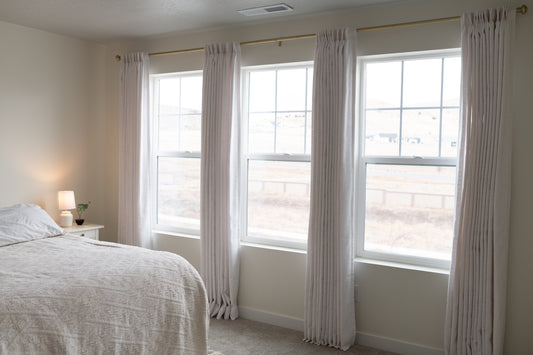
Lena Linen Curtains
Image Gallery


